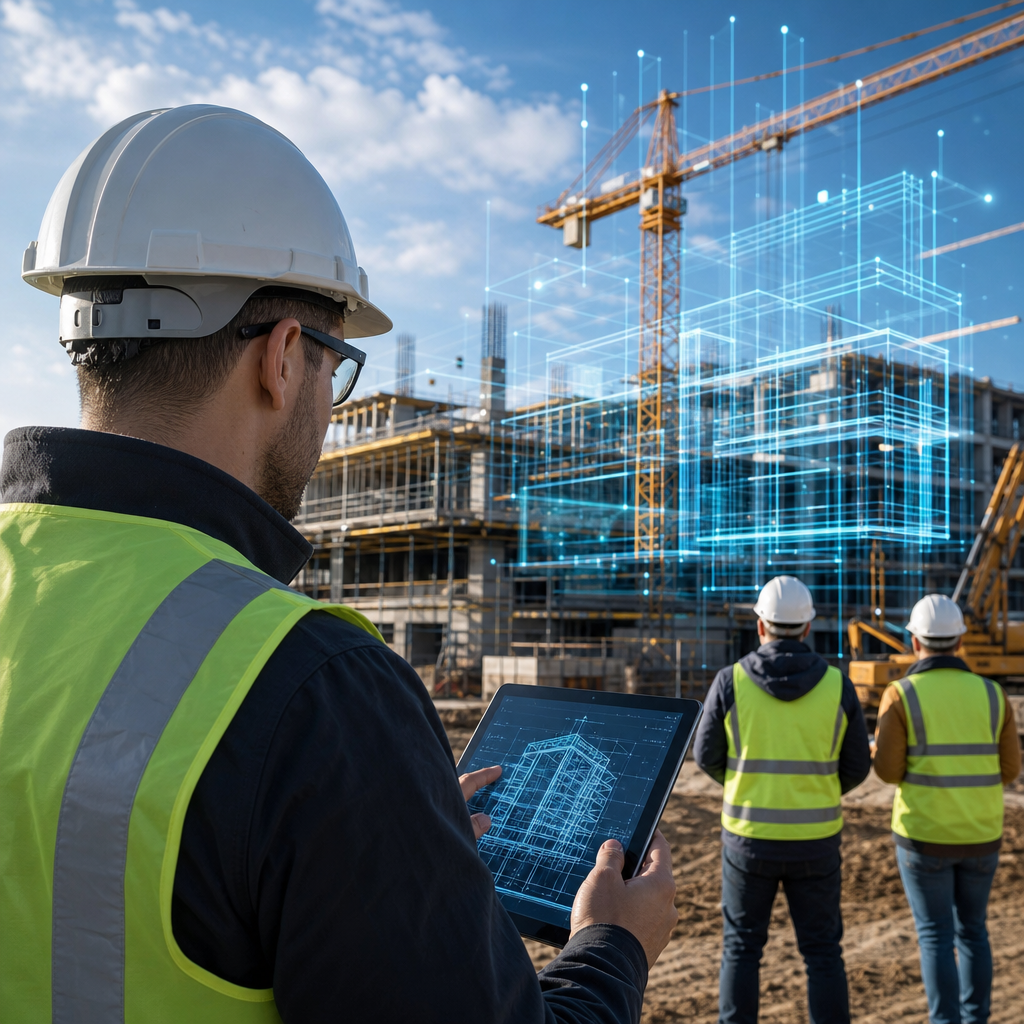
How AI Is Transforming Construction — With Cyber Safety Built In
Construction has always been an industry of moving parts: multiple crews, shifting timelines, changing site conditions, and constant coordination across owners, contractors, subcontractors, and suppliers. In that kind of environment, even small communication gaps can become expensive problems. A missed update can trigger rework. A delayed material order can push back a milestone. A design conflict can ripple through the schedule and inflate costs.
That is why AI is gaining traction in construction. Not because it is trendy, but because it can help solve some of the industry’s most persistent operational pain points. Used well, AI can improve project coordination, detect risks earlier, and reduce delays, rework, and cost overruns. But there is one non-negotiable condition for success: construction firms must build cyber safety into AI adoption from the start.
The real opportunity is not just smarter construction. It is more predictable, more resilient, and more secure construction.
AI as the new coordination layer
One of the biggest challenges in construction is fragmentation. Information often lives in separate systems, separate email chains, separate spreadsheets, and separate teams. AI helps close those gaps by acting as a coordination layer across the project lifecycle.
Instead of waiting for a human to manually reconcile every update, AI can ingest project data from schedules, RFIs, submittals, change orders, procurement records, and field reports. It can then surface what matters most: unresolved dependencies, likely bottlenecks, and issues that need attention before they disrupt the job.
This matters because construction projects rarely fail in one dramatic moment. They slip slowly, one missed handoff at a time. AI helps teams see those handoffs more clearly and respond faster. For project managers, that means less time chasing information and more time managing execution. For executives, it means better visibility into schedule health. For owners, it means a greater chance of getting projects delivered on time and on budget.
AI also improves the quality of coordination meetings and daily execution reviews. Instead of spending valuable time debating which version of the schedule is current or whether an issue has already been resolved, teams can use AI-generated summaries and alerts to focus on decisions. That shift from administrative cleanup to active management is where much of the value is created.
Early risk detection changes the economics of a project
The most valuable AI systems in construction are not just reactive reporting tools. They are early warning systems.
AI can identify patterns that suggest a project is drifting off course long before the problem becomes visible in the final numbers. For example, it can flag a procurement delay that may affect a critical path item, detect a trade coordination issue that could cause stacking on site, or spot a budget trend that suggests scope creep is building beneath the surface.
That early detection matters because the cost of fixing a problem rises sharply the later it is found. A risk caught in time can often be managed with a schedule adjustment, a resource shift, or a procurement change. The same risk discovered too late can turn into rework, delay claims, overtime costs, or a full-blown dispute.
In other words, AI adds value not just by predicting problems, but by giving teams time to act on them. That is especially important on complex projects where a small disruption in one trade can cascade across multiple workstreams.
When AI is paired with disciplined project controls, it becomes easier to identify where intervention will have the most impact. That means leaders can prioritize the risks that matter most rather than reacting to every issue at the same level of urgency.
Reducing delays, rework, and cost overruns
Construction companies do not need AI for the sake of novelty. They need it because delays and rework are expensive. Every hour of idle labor, every miscommunication between trades, and every design conflict that reaches the field can erode margins.
AI addresses this in three important ways. First, it improves scheduling discipline. By identifying dependencies and likely delays earlier, AI helps teams sequence work more effectively and avoid avoidable bottlenecks. Second, it reduces rework. When project data is easier to reconcile and issues are surfaced sooner, teams can catch inconsistencies before they become costly mistakes in the field. Third, it helps control cost overruns. Better coordination and faster issue resolution reduce the likelihood of expensive change-order churn, emergency procurement, and productivity losses caused by schedule slippage.
This is why AI in construction is increasingly being viewed as a margin protection tool, not just an efficiency tool. In a business where profits can be thin and timelines are unforgiving, even modest improvements in execution can make a meaningful difference. In practical terms, AI can help teams protect both schedule and budget by making project information easier to act on in real time.
The benefits are not limited to large firms or mega-projects. Smaller contractors can also gain from faster issue detection, cleaner handoffs, and better visibility into where time and money are being lost. The common thread is the same: fewer surprises, fewer preventable mistakes, and more control over execution.
Why cyber safety has to be part of the plan
The more digital construction becomes, the more cyber risk matters.
Modern construction workflows depend on cloud platforms, BIM repositories, connected devices, mobile apps, remote inspections, third-party vendors, and AI tools that may access sensitive project data. That creates a much larger attack surface than the industry has traditionally managed.
A cyber incident can do more than expose information. It can stop work. Ransomware can lock teams out of schedules and documents. Unauthorized access can compromise design files or estimates. Tampering with project records can create legal and financial damage. Even a minor security failure can interrupt coordination across a complex project.
That is why any AI strategy in construction should include a cyber safety plan from the beginning. At a minimum, that plan should cover:
- role-based access controls
- multi-factor authentication
- secure cloud architecture
- encryption for sensitive data
- vendor and subcontractor risk assessments
- logging and audit trails for AI outputs
- data classification policies
- incident response and recovery procedures
- clear rules for how AI tools can access and use project information
Cyber safety is not a separate issue from AI adoption. It is what makes AI adoption sustainable. Without strong security, the very systems meant to improve performance can become sources of operational disruption, legal exposure, and reputational damage.
Leaders should also treat cybersecurity as an ongoing operational discipline, not a one-time checklist. That means reviewing permissions regularly, validating vendors, testing recovery plans, and ensuring employees understand how to use AI tools safely and appropriately.
What leaders should look for in AI tools
Not every AI solution in construction will deliver the same value. The best tools are the ones that fit into existing workflows and solve real project problems without forcing a disruptive overhaul.
Construction leaders should favor systems that:
- integrate with BIM, ERP, document control, and project management platforms
- provide clear, auditable outputs
- improve visibility across teams and subcontractors
- offer practical risk alerts rather than vague analytics
- support secure access and strong governance
- demonstrate measurable reductions in delay, rework, or administrative burden
The winners will be the tools that become part of the operating rhythm of the project, not another system people have to fight with. That means ease of use matters, but so does traceability. If users cannot understand where an alert came from or how a recommendation was generated, adoption will stall.
It also means leaders should ask hard questions before deployment. Where is the data stored? Who can access it? How are outputs logged? What happens if the system is unavailable? Those questions are not obstacles to innovation. They are what make innovation usable at scale.
The bigger business case
The business case for AI in construction is straightforward: better coordination, earlier risk detection, and fewer costly mistakes translate into stronger project performance.
That means:
- lower cost of poor quality
- fewer delays and schedule disruptions
- less rework and waste
- better use of labor and materials
- improved confidence from owners and lenders
- more predictable margins for contractors
And when cyber safety is built in, firms also protect the continuity and integrity of the very systems they depend on to deliver work. That creates a stronger operating foundation for both current projects and future bids.
The broader payoff is strategic as well as financial. Firms that can deliver projects with greater consistency, better visibility, and stronger security will be better positioned to win business in a market that increasingly values reliability as much as price.
The bottom line
AI is transforming construction by helping teams coordinate better, spot risks sooner, and avoid the delays and overruns that have long weighed on project performance. But the true breakthrough is not AI on its own. It is AI deployed within a cyber-safe operating model that protects data, preserves trust, and supports resilient execution.
For construction firms, the message is clear: the future is not just digital. It is intelligent, coordinated, and secure.