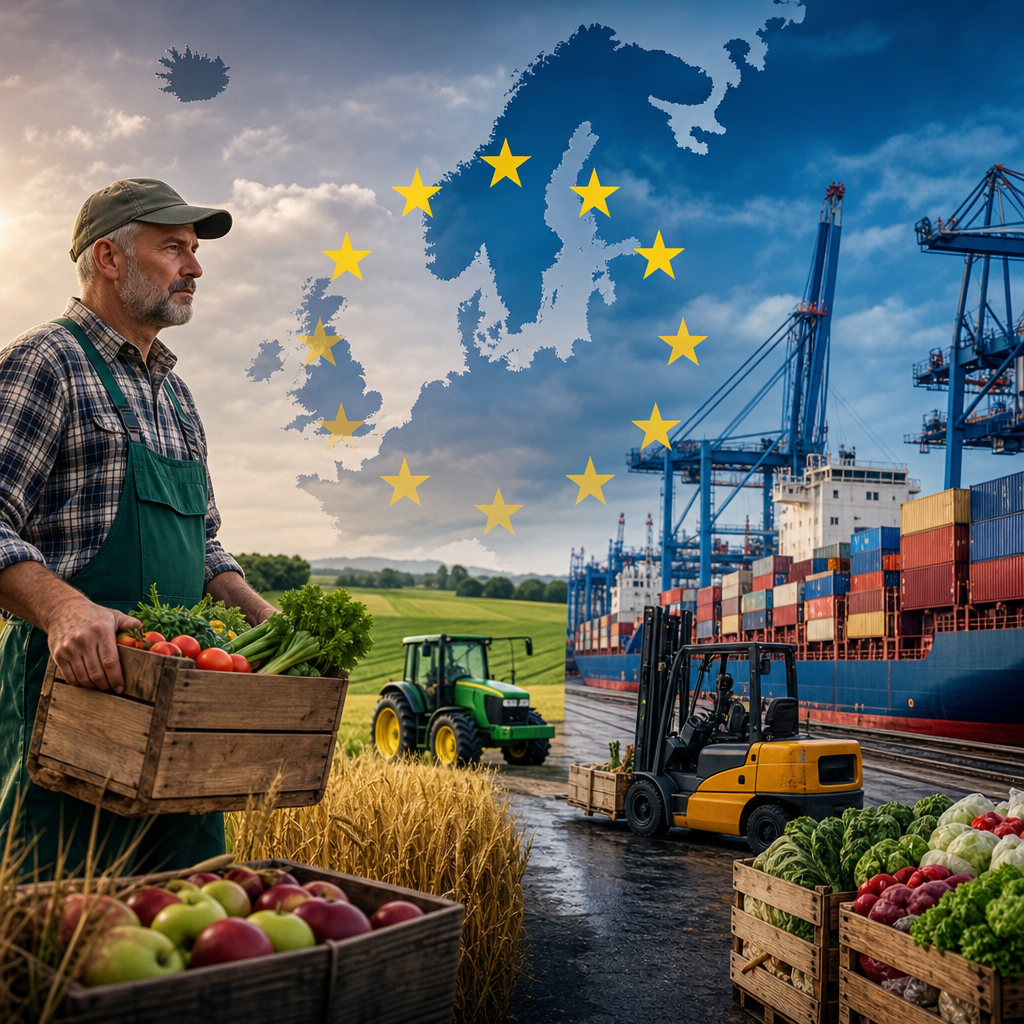
Tariffs Are Rewiring European Agriculture’s Supply Chains
For European agricultural producers, tariffs and other trade measures are more than a line on a customs declaration. They can change where fertilizer and feed come from, influence export opportunities and shift bargaining power between farmers, traders, processors and buyers. The effects can show up in freight costs, delivery times and working capital before they are fully visible in farm-gate prices.
The impact is rarely uniform. A measure that makes imported grain less competitive may support local growers while raising feed costs for livestock farms. Carbon-related obligations on imported fertilizer may favor lower-emission production, but could also add complexity and cost for buyers. The practical questions are: which products and markets are exposed, what alternatives are viable, and who is positioned to absorb or pass on the cost?
1. Follow the cost beyond the border
A tariff makes a product from a particular origin more expensive to import. Buyers may pay the additional cost, switch suppliers, reroute shipments or increase inventories. Each response can affect freight, availability, delivery schedules and working capital. Those effects can then move through importers, processors, farms and, potentially, consumers.
Direct exposure is not the same as market exposure. A grower who does not buy the affected product might benefit if competing imports become less attractive. A livestock producer could face the opposite outcome if feed becomes more expensive or harder to source. A processor may be squeezed between higher input costs and customer contracts that limit its ability to raise prices.
A tariff announcement alone is not a reliable price forecast. Before drawing conclusions, identify the affected product and origin, check when the measure takes effect, and assess how easily buyers can switch to alternatives. The delivered cost of replacement supply—not just the headline tariff rate—will help determine where the pressure lands.
2. Grain and oilseed measures create winners and pressure points
In July 2024, the European Union introduced higher tariffs on cereals, oilseeds and related products originating in Russia and Belarus. The measures were intended to restrict imports from those origins. For European producers, the market effect depends in part on whether buyers can replace the supplies easily and at a comparable delivered cost. The relevant EU regulation is available on EUR-Lex.
If alternative exporters can fill the gap quickly, the main result may be a change in sourcing rather than a sharp rise in prices. If replacement supplies are more expensive, constrained or slower to deliver, added costs may flow to feed mills, livestock farms and food processors. Freight and handling costs can matter as much as the commodity price.
That creates different outcomes across agriculture. European grain and oilseed growers may face less competition from the affected origins, while poultry, pork and dairy producers may be more exposed to feed-price pressure. Traders and processors must also consider origin documentation, routing and contract terms, especially when goods pass through multiple countries.
Producers should compare delivered prices across origins and track delivery premiums, availability and lead times. These indicators can help distinguish a supply that is simply being rerouted from one that is becoming genuinely scarce.
3. Fertilizer combines carbon, energy and currency risks
The EU’s Carbon Border Adjustment Mechanism (CBAM) entered its definitive phase in 2026 and covers certain fertilizers. CBAM is not a conventional customs tariff. It is designed to account for emissions embedded in covered imports, with obligations applying under its rules to importers of covered goods. For farmers, however, the commercial question is familiar: whether the cost of an essential input will rise, and how suppliers will reflect that cost in prices.
Fertilizer prices are also shaped by natural-gas costs, production capacity, freight and exchange rates. Carbon-related costs and emissions-reporting requirements add another layer. The impact will vary by product and supplier, including the emissions intensity of production and the availability of reliable emissions data. Suppliers with lower-emission production and clear documentation may be better positioned than those with limited supply-chain visibility. The European Commission provides an overview of the CBAM rules.
Farmers can assess the cost alongside agronomic needs, crop rotations and application timing. Improving nutrient efficiency can support farm economics, but indiscriminate reductions may affect yields or quality. The aim is to evaluate input decisions against both cost and crop requirements, rather than assume that using less fertilizer is always the right response.
A useful fertilizer budget should account for delivery, timing, currency and supplier reliability as well as the quoted price. Investors can also examine manufacturers’ energy exposure, import reliance and ability to document emissions.
4. Export concentration can turn trade disputes into margin shocks
Trade barriers can affect exporters through more than the final duty. Investigations may create uncertainty that influences shipment timing, contract negotiations and buyer behavior. Where products have few alternative markets, uncertainty can itself weaken a seller’s position.
The China-EU pork case illustrates how a trade investigation can progress into a concrete market-access measure. China’s investigation into certain EU pork imports led to anti-dumping duties announced in 2025. The duties apply to covered products and exporters at rates that vary by company, rather than representing a uniform charge across every European pork shipment. For affected businesses, the commercial impact depends on the products in scope, their destination mix and the availability of alternative buyers.
Some cuts, grades or processed products are harder to redirect than others. If exporters shift volumes into alternative markets, they may have to accept lower prices, pressuring processor margins and potentially farm-gate prices. The lesson extends beyond pork: export value alone is not a sufficient measure of resilience.
Producers and investors should examine sales by destination, product and customer, then assess how much volume could be redirected without substantial discounting. They should also distinguish between the stages of a trade case: an investigation, provisional measures and final duties can have different effects on timing, costs and exposure.
5. Contracts and currency determine who carries the burden
The effect of a trade measure depends on whether a business buys or sells the affected product, whether substitutes are available and how much negotiating power it has. A measure that supports local grain prices may squeeze livestock margins through higher feed costs. A fertilizer cost increase may directly affect crop producers, while processors may be unable to pass higher procurement costs on if contracts or competition constrain pricing.
Currency movements can add to or offset those pressures. Many agricultural commodities and inputs are priced internationally in US dollars. A weaker euro can increase the euro cost of imports even when tariff rates are unchanged; a stronger euro may offer some relief. Freight, energy prices and inventory levels also influence how quickly cost changes reach a business.
For producers, the first step is to map exposure at product level. Which inputs are imported, and from where? How much revenue depends on export markets? Do contracts specify who bears changes in duties, freight or currency? Understanding those terms can reveal vulnerabilities that are easy to miss when looking only at sales and input prices.
6. Build resilience before a disruption arrives
When trade rules change, businesses may seek another supplier, alter a product or route, build inventory, or absorb the additional cost. Each option has limits. A substitute feed ingredient may not be available at scale; a new supplier may need quality checks; and rerouting can increase freight time and working-capital needs. Passing costs on depends on the seller’s bargaining position and the terms of customer contracts.
Supply-chain visibility is therefore a practical advantage. Producers and processors need to understand more than who issued an invoice. They need to know product origin, how goods were transformed, which trade rules apply and—where relevant—what emissions information is available. Incomplete records can contribute to delays, unexpected costs or difficulty demonstrating compliance.
A practical resilience plan can begin with these steps:
- Map tariff-sensitive inputs and export revenue by product, origin and destination.
- Identify alternative suppliers and confirm that substitutes meet agronomic and quality requirements.
- Review contracts for changes in duties, freight, currency and delivery terms.
- Stress-test margins against higher input costs, lower output prices and delayed shipments.
- Improve origin and emissions documentation across the supply chain.
- Compare the cost of additional inventory with the potential cost of disruption.
The goal is not to eliminate every exposure or stockpile every input. It is to understand where the business is most sensitive and establish workable options before a change becomes urgent.
7. Watch for signals beyond the tariff announcement
The most useful signals include investigations progressing to provisional or final measures, changes to origin rules or product classifications, and new measures affecting farm inputs. For fertilizer buyers, the implementation of CBAM and access to supplier emissions data are important. For exporters, a change in market access may matter as much as the duty rate itself.
Commercial behavior can reveal pressure early. Shifts in sourcing, inventory, contract terms, freight premiums and delivery times may show how businesses are adapting before the effects appear in reported results. Track those developments alongside input prices, export volumes, currency movements and energy costs.
Tariffs are best understood as a source of uneven margin pressure—not as an automatic bullish or bearish signal for European agriculture. The better-positioned businesses are not simply those protected by a border measure. They are those that understand their exposure, maintain credible alternatives, document their supply chains and adapt without sacrificing commercial or agronomic discipline. The real effect of a tariff is found not only at the border, but in the choices it forces across the farm supply chain.